Arashino Isamu
Memoirs of a GeishaArashino Isamu is a kimono maker whose home and workshop become Sayuri’s place of refuge during the war. Once known for making Yuzen kimono with his wife and daughter, he is compelled by wartime demands to turn that silk-working expertise toward parachutes. When Sayuri arrives, the household offers her work and shelter; afterward, Arashino begins making kimono again, and she helps him at the dye vats. His story links the beauty of geisha dress to the labor, scarcity, and changing uses of the craft that sustain it.
Identity and Craft
Before the war, Arashino and his family made kimono in the Yuzen style, a craft for which he was famous. His home, also his workshop, stood beside the shallows of the Kamo River, about five kilometers upstream from Gion. The setting matters to Sayuri’s altered life: the river flows past the place where she works, while the workshop houses both the family’s livelihood and the people who depend on it.
Kimono in the novel are not simply garments of display. Their making depends on specialized skill and costly materials, and the wartime conversion of the Arashinos’ work from Yuzen robes to parachutes shows how quickly an established art can be redirected by national need. Silk workers were assigned to sewing parachutes because they already knew how to handle the material. Arashino’s craft therefore survives the war not through uninterrupted production of kimono, but through the practical transfer of its techniques to a military purpose.
Refuge and Wartime Work
Nobu arranges for Sayuri to live with Arashino’s family and learn the parachute work. He describes the home as a refuge, gives Sayuri its address, and undertakes to make the necessary arrangements with the authorities. The family is willing to take her in. For Sayuri, who has been separated from the life she knew in Gion, this arrangement supplies both a place to stay and a job she can learn quickly.
The refuge is defined by labor and privation rather than comfort. Sayuri works with the Arashinos sewing parachutes by day and sleeps at night on futons spread across the workshop floor, beside their daughter and grandson. With charcoal scarce, they burn compressed leaves, newspapers, and magazines for warmth. Their food includes soybean dregs normally fed to livestock and nukapan, made by frying rice bran in wheat flour; only occasionally do they get potatoes or sweet potatoes, dried whale meat, seal sausage, or sardines. The workshop preserves a household through work, but it cannot shield its residents from the wider shortage.
Arashino’s family also bears private loss. His daughter’s husband dies during the war, leaving her to pour herself into caring for her young son and sewing parachutes. As she grows thinner, Sayuri sees her attachment to the child as a last hold against collapse. This portrait places the family’s labor within grief as well as material hardship: parachute sewing is work imposed by wartime necessity, while care for the child becomes the bereaved mother’s sustaining purpose.
Kimono, Scarcity, and Exchange
The Arashinos’ former livelihood remains present even when they can no longer rely on making kimono. When the grandson, Juntaro, cries from hunger, Arashino decides to sell a kimono from his collection. Sayuri describes wartime survival as an onion life: a person loses one layer at a time, with pain accompanying each reduction. The garment’s value is thus both cultural and immediate. A kimono that once belonged to a renowned collection becomes a way to raise cash for food.
The sales bring Arashino into contact with Mother, who has become wealthy through gray-market dealings in other people’s heirlooms. He asks Sayuri to contact her when he has a kimono to sell, apparently hoping that she will set it aside until he can afford to buy it back. The expectation is not fulfilled: Mother says she cannot find the pieces again. The episode sets the maker’s attachment to his collection against a market in which scarcity gives other people the opportunity to profit. The kimono passes out of the family’s hands, and the prospect of recovering it remains uncertain.
The value attached to kimono is established earlier through the okiya’s stores. Sayuri finds cases packed with robes, estimates that the collection is worth about twice as much as the villages of Yoroido and Senzuru together, and learns that the most expensive apprentice garments are stored elsewhere in a rented vault. That background sharpens the change in Arashino’s circumstances: clothing once accumulated and protected as a major asset can, under wartime pressure, be sold one at a time to meet immediate needs.
Postwar Change and Sayuri’s Work
Within a year of Japan’s surrender, Arashino is encouraged to resume making kimono. Sayuri, who knows how to wear them but not how to make them, is assigned to tend the dye vats in the basement of the workshop annex. The work is harsh: the only affordable fuel is tadon, coal dust bound together with tar, whose burning produces a terrible stench. Arashino’s wife teaches her to gather the leaves, stems, and bark used to prepare dyes, extending Sayuri’s work from tending the vats to helping supply their materials.
The new work leaves a physical mark on Sayuri. One of the dye ingredients, whose identity she never discovers, causes her skin to become pickled: her once carefully tended hands peel and turn the color of bruises. This consequence gives the postwar revival of production a bodily cost. The return to kimono-making is not a simple restoration of the old order; it puts Sayuri into labor that changes her hands and makes her feel distant from her former identity as a dancer and geisha.
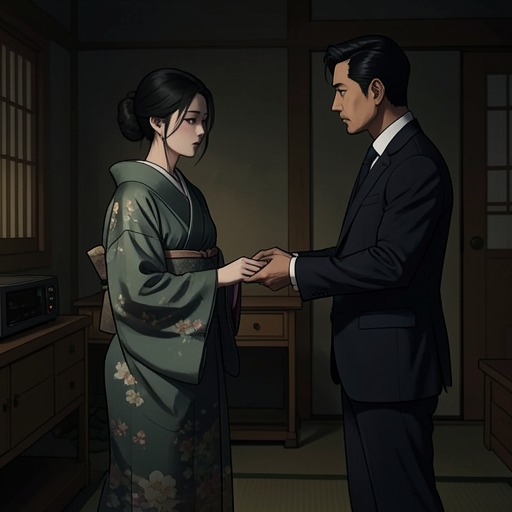
By the time Nobu visits in November, three years after the war’s end, Sayuri is still warming her hands over the vats. Mrs. Arashino comes downstairs to tell her that a visitor is waiting, and Sayuri finds Nobu seated with Arashino in the workshop, holding an empty teacup. Arashino rises and leaves them alone to talk, welcoming Nobu’s visit. The scene marks the workshop as a continuing point of connection between Sayuri’s wartime refuge and the people from her earlier life, without making Arashino’s household merely a temporary stop in her story.
Narrative Significance
Arashino’s role is defined less by speeches than by the practical shelter his household provides and by the work that holds it together. His expertise moves from celebrated Yuzen kimono to parachutes and back to garments after the surrender; that sequence makes the history of the craft visible through changes in what its makers are permitted, or able, to produce. The collection’s transformation from protected wealth into emergency cash further connects material beauty to economic vulnerability.
For Sayuri, the workshop is where displacement becomes a daily routine of sewing, sleeping on the floor, managing hunger, and tending dye. The narrative’s attention to fuel, food, fabric, and damaged hands gives wartime hardship a concrete scale. Arashino’s household cannot reverse the losses around it, but its willingness to employ and shelter Sayuri allows her to endure them. In the postwar return to kimono production, survival does not mean recovering an untouched past: the craft resumes, but the people who make it, and the circumstances in which they work, have changed.